
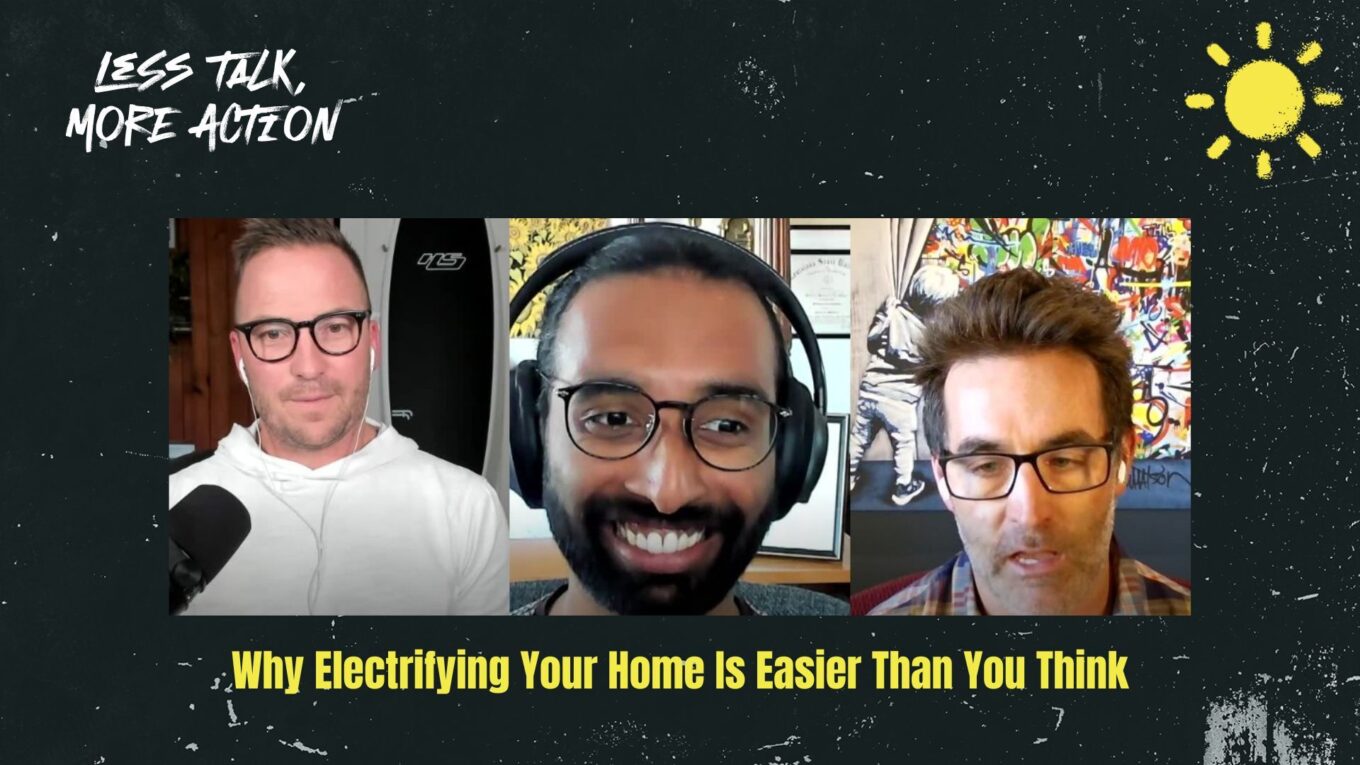
From Rockets to Heat Pumps
Joel and Owen peppered me with questions about heat pumps, bad incentives, and why on earth someone would leave rockets for HVAC.
🎧 Listen to the full episode
The Question Everyone Asks: “Will a Heat Pump Save Me Money?”
Let’s start with the uncomfortable part.
Owen opened with the question I hear constantly:
“How do we get the masses to adopt heat pumps when gas is so much cheaper than electricity, especially in California?”
-
Heat pumps really are 3–4x more efficient than gas furnaces.
-
But in much of California, electricity is also 3–4x more expensive than gas.
-
That means the operating costs often come out roughly even, maybe a bit better, maybe a bit worse, depending on the house and rate structure.
I wish I could tell people, “Install a heat pump and your bills will drop by 50%.” Right now, in most of California, I can’t. And I don’t try to force that narrative.
So instead of pretending there’s a huge savings where there isn’t, I lean on what is true:
-
You get heating and cooling in one system.
-
Comfort is better and more stable – no more furnace cycling on and off at full blast.
-
There’s no combustion, no carbon monoxide risk.
-
With incentives, upfront cost is often lower than installing a traditional AC and furnace.
Is it a financial slam dunk everywhere? No.
Is it a better system that future-proofs the home, often at similar lifetime cost? In most cases, yes.
A Quick Heat Pump Explainer
When I say “3–4x more efficient,” here’s what I mean in plain terms:
-
A gas furnace is ~80–95% efficient. You burn gas, some energy goes out the flue, the rest warms your home. You’re creating heat from fuel.
-
A heat pump doesn’t “make” heat; it moves it.
-
Even on a cold day, molecules in the air are moving—that motion is heat.
-
A heat pump pulls that heat out of the air, concentrates it, and moves it indoors.
-
It’s the same physics as your refrigerator or air conditioner, just run in reverse in winter.
-

Heat pumps move heat instead of generating it
How I Ended Up Trading Rocket Engines for Heat Pumps
People love to ask how I went from working at companies like SpaceX and Blue Origin to HVAC.

Standing by a Blue Origin lunar lander – I helped design its engine
To be honest, I didn’t wake up one day and ~decide~ to go into heat pumps. It was a winding path, but I’m grateful I found my way to this space.
When I eventually started DMing homeowners on Reddit and Nextdoor asking them, “What was your experience getting a heat pump?”, the answers were almost all identical:
-
“It’s really expensive.”
-
“I don’t trust my contractor.”
-
“I’m getting conflicting advice.”
The Bar Is Still So Low
What’s wild, and a little sad, is how low the baseline for “good contractor” still is.
-
My mom texts four contractors; one replies. That’s who gets the job.
-
My in-laws had multiple appointments rescheduled by their solar installer, often with techs showing up hours late.
-
Owen talked about winning a $7M contract basically by just being responsive.
This is part of why I keep saying:
If you want to do something meaningful in climate and have a high tolerance for chaos, start an HVAC company.

Hearing the same frustrations over and over led me to starting my own heat pump company
You don’t need to be the biggest. You just need to show up, do what you say you’re going to do, and care about the quality of your work.
Incentives, the IRA, and Why Some “Climate Money” Backfires
-
People heard for years that huge electrification rebates were coming.
-
Some homeowners delayed critical work, hoping for $8,000+ off a heat pump.
-
In places like Northern California, once funds finally went live, they were gone in a month or two.
So what did we actually achieve?
-
We froze some homeowners in place waiting for programs.
-
We created a huge expectation mismatch.
-
We did not fundamentally change the default equipment being installed.
-
The cost difference between a one-way AC and a heat pump is basically a reversing valve (~$30–$50 in parts).
-
Every major manufacturer already sells both the AC and corresponding heat pump versions of their product.
-
If we subsidized that tiny delta at the manufacturer or distributor level, one-way ACs could just quietly fade out.
Every “normal” AC replacement would automatically be a heat pump. Not because the homeowner read a whitepaper, but because that’s what’s on the truck.
Perfectionism Is Quietly Killing Decarbonization
-
Air seal and insulate
-
Replace windows
-
Upgrade panel and wiring
-
Maybe, finally, install the heat pump
On a whiteboard, that looks great. In real life:
-
Furnaces die right before a cold snap.
-
People don’t have unlimited capital, bandwidth, or patience.
-
The more steps you stack up front, the more likely they are to say:
“Just put in another gas furnace.”
In California, at least, I’m very comfortable with electrify first, optimize later:
-
Even leaky, old homes can usually be handled by a modestly sized inverter heat pump.
-
If you upgrade windows and insulation later, the same heat pump just runs at a lower output.
Coming from rocketry, I think in test cycles. You build, test, learn, adjust. If you wait for the perfect model, you never launch anything.
Why I’m Still Optimistic
We often talk about the ugly in this newsletter – the barriers that are slowing down widespread heat pump adoption. I see a lot of dysfunction up close: bad incentives, messy rates, hilariously low contracting standards.
But here’s what gives me real hope:
I’m in a Facebook group with a bunch of small HVAC contractors. Recently someone asked: “Who’s installing heat pumps these days?”
A couple of years ago, that would’ve drawn skeptical or hostile replies. This time, I’d guess 80–90% of the responses were some version of:
-
“We’re doing a lot of heat pumps now.”
-
“Most of our installs are heat pumps.”
-
“We only do heat pumps.”
Not from giant, well-branded west coast climate companies. From one- and two-truck shops all over the place.
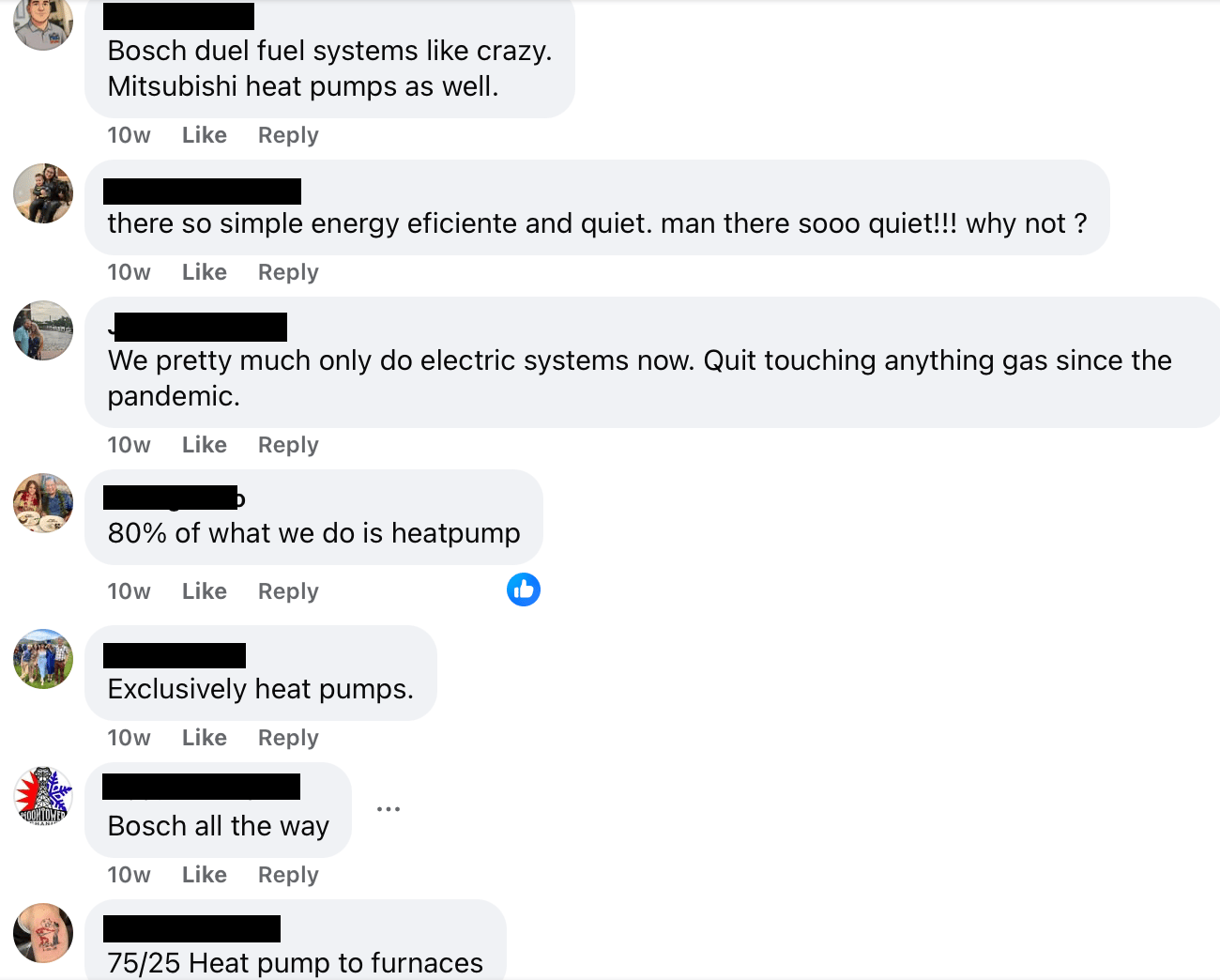
This is market transformation in action
That’s the kind of quiet, unglamorous market shift that actually matters.
So I’m going to keep doing what I’ve been doing: Talking about heat pumps and installing them.
If any of this nudges one more person to leave the sidelines – whether that means starting a trades business, fixing a broken rate design, or just replacing a dead furnace with a heat pump instead of another gas box – it’s worth it.